
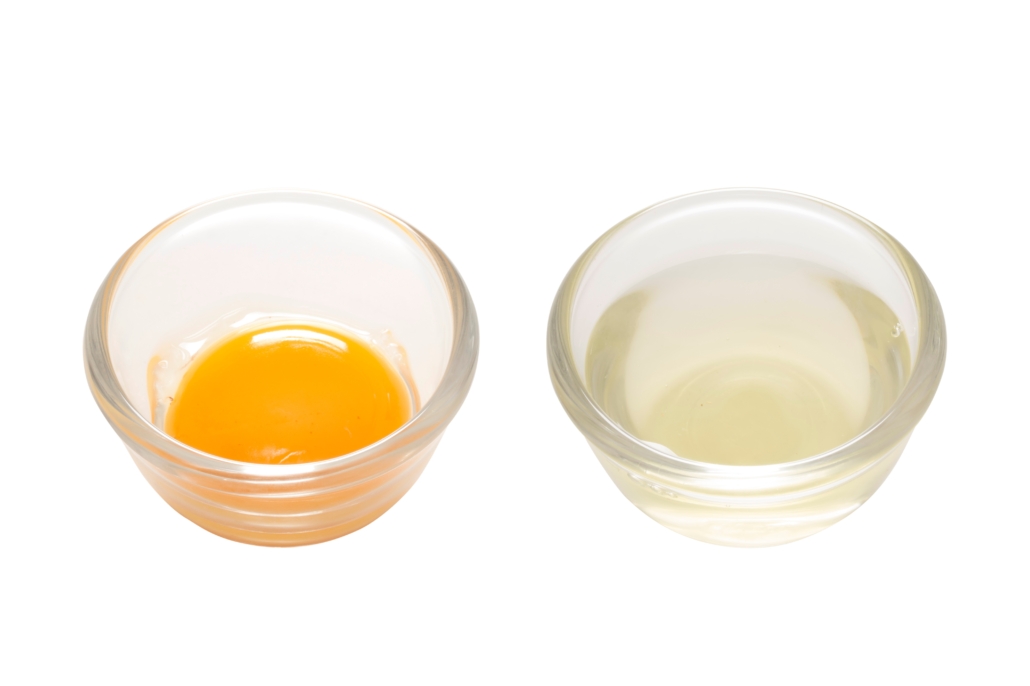
Eggs are one of the most convenient and nutrient-dense foods on earth. Yet, in recent decades, a supposedly “health-conscious” trend has taken hold that demonizes egg yolk and valorizes egg whites. Does this whites-over-yolks trend have merit, or is it bogus? In this article, we’ll consult the current nutritional science to tell the true story of egg yolk vs egg white.
Cholesterol in Egg Yolk vs Egg White?
The egg yolk vs egg white debate can be traced to the 1970s when nutritionists hypothesized that the cholesterol in egg yolks increased blood cholesterol levels and, in turn, increased the risk of heart disease. [1]
The yolk of 2 eggs provides 185mg of cholesterol. Meanwhile, egg whites have 0mg of cholesterol.
But modern science tells us that for most people, dietary cholesterol does not significantly increase the cholesterol in our blood. The cholesterol-raising effects of eggs are confined to a minority of people with specific genetic traits that cause cholesterol hyperabsorption through the intestines. [2]
A large-scale 2020 meta-analysis of numerous studies found that consuming one egg per day was not associated with the risk of cardiovascular disease. And that consuming eggs may decrease the risk of heart disease in Asian populations.3
These findings are in line with numerous individual studies that show that for healthy people, consuming 1-2 eggs per day does not negatively impact cholesterol levels or increase the risk of heart disease. [3] [4] [5] [6]
Studies on populations with metabolic disorders have found that consuming whole eggs typically increases levels of (good) HDL cholesterol while leaving (bad) LDL cholesterol the same or only slightly raised. [7] [8]

Choline in Egg Yolk vs Egg White
Another aspect of the egg yolk vs. egg white debate is how the choline in egg yolk affects heart health.
Two egg yolks provide 278.9mg of choline or 51% RDV, making them an exceptionally high choline food. Egg white has essentially no
Though choline is an important nutrient, some of it is metabolized into an oxide called TMAO. High concentrations of TMAO are a risk factor for heart disease. [9]
However, consuming eggs has only been shown to increase TMAO levels within hours after eating eggs. [10] [11]
High-quality controlled feeding studies have found that consuming 2-3 eggs per day was not shown to increase TMAO concentrations. [12] [13]
In contrast, consuming fish has been shown to have a consistent and significant impact on circulating TMAO. [14]
With regards to egg yolk, researchers believe that the impact of choline is highly individual and depends on many variables, including kidney function and gut microbiota. [15]
Calories in Egg Yolk vs Egg White
Egg yolk is a calorically dense food with 109 calories per 34 grams.
In contrast, egg white is a low-calorie food, contributing only 17 calories per 34 grams.
This disparity makes egg whites popular among people on calorie-restricted diets
It’s worth highlighting that if you’re restricting calories to reduce weight, research shows that low-carb diets without restricting calories are more effective for reducing and keeping weight off. Whole eggs are an excellent low-carb high-fat diet food. [16]
Egg Yolk vs Egg White Nutrition
Whole eggs provide all the nutrients needed for an entire animal to form, and most of these nutrients are concentrated in the yolk.
When considering egg yolk vs egg white, for most people, it just doesn’t make sense to sacrifice the nutrients in the yolk.
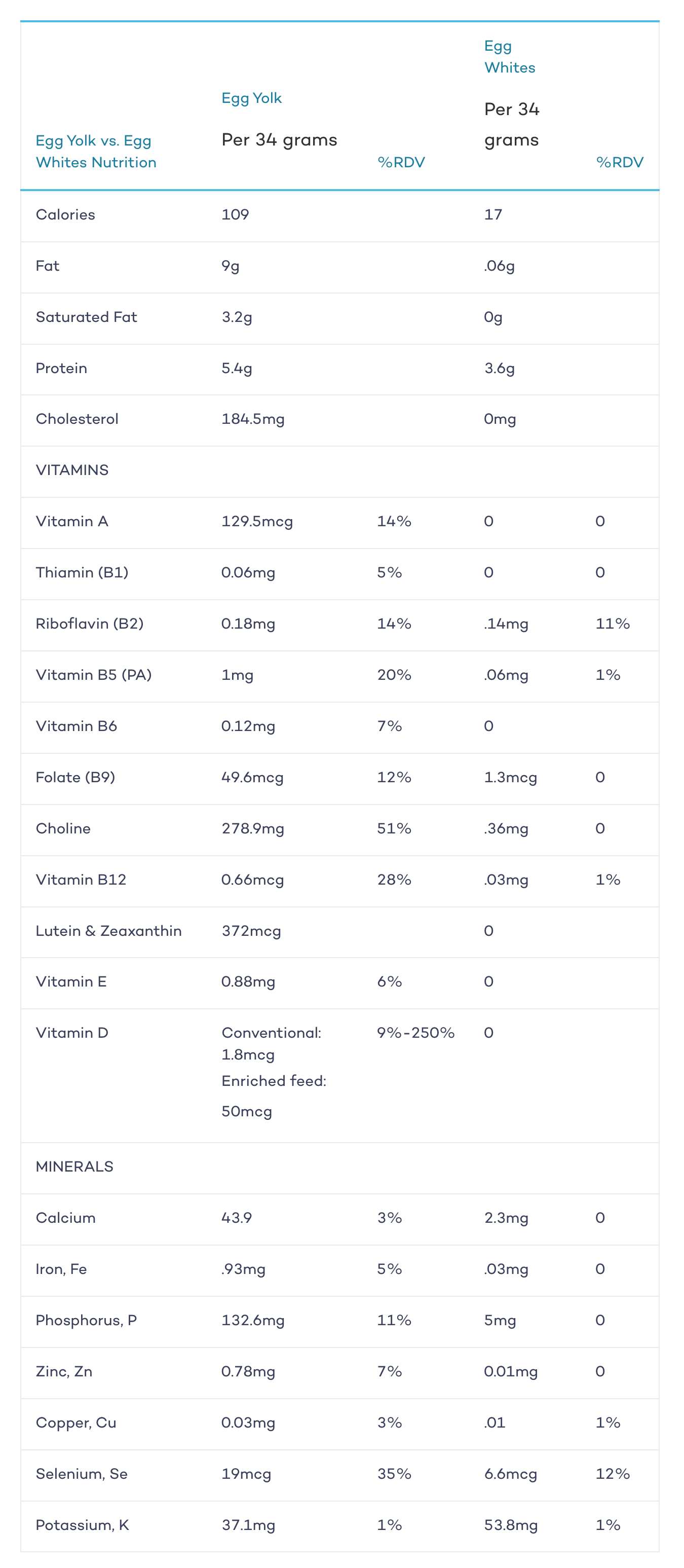
The abundance of nutrients in egg yolk directly contributes to powerful health benefits. Egg whites simply can’t compete. Here’s a rundown of the benefits you get from egg yolk that you’ll miss out on if you opt for egg whites alone:
- Intestinal health: specific proteins in egg yolk protect intestines from oxidative stress [17]
- Brain health: Choline in egg yolk promotes dopamine and serotonin production, improves memory and cognitive function, and supports fetal brain development when consumed during pregnancy. [18] [19] [20]
- Selenium in egg yolk supports thyroid health and immune function, provides antioxidant protection, and supports lung health. [21] [22] [23] [24] [25] [26]
- Lutein and zeaxanthin: These compounds act as powerful antioxidants that protect eyes from degradation, cataracts, and ultraviolet rays. They also protect protein, fat, and DNA from oxidation. [27] [28] [29]
Protein in Egg Yolk vs Egg White
People often think of egg white as the part of the egg with protein and egg yolk as the part that contains cholesterol, fat, and other nutrients. But egg yolk has ⅔ the amount of protein as the equivalent size serving as egg whites.
For example, there is 7.2g of protein per 68 grams of egg whites (2 eggs).
Compared to 10.8g of protein per 68 grams of egg yolk. Granted, you’d need four eggs to get 68 grams of yolk.
If we’re measuring per single egg, the white of 1 egg provides 3.6 grams, while the yolk of one egg provides 2.7 grams of protein.
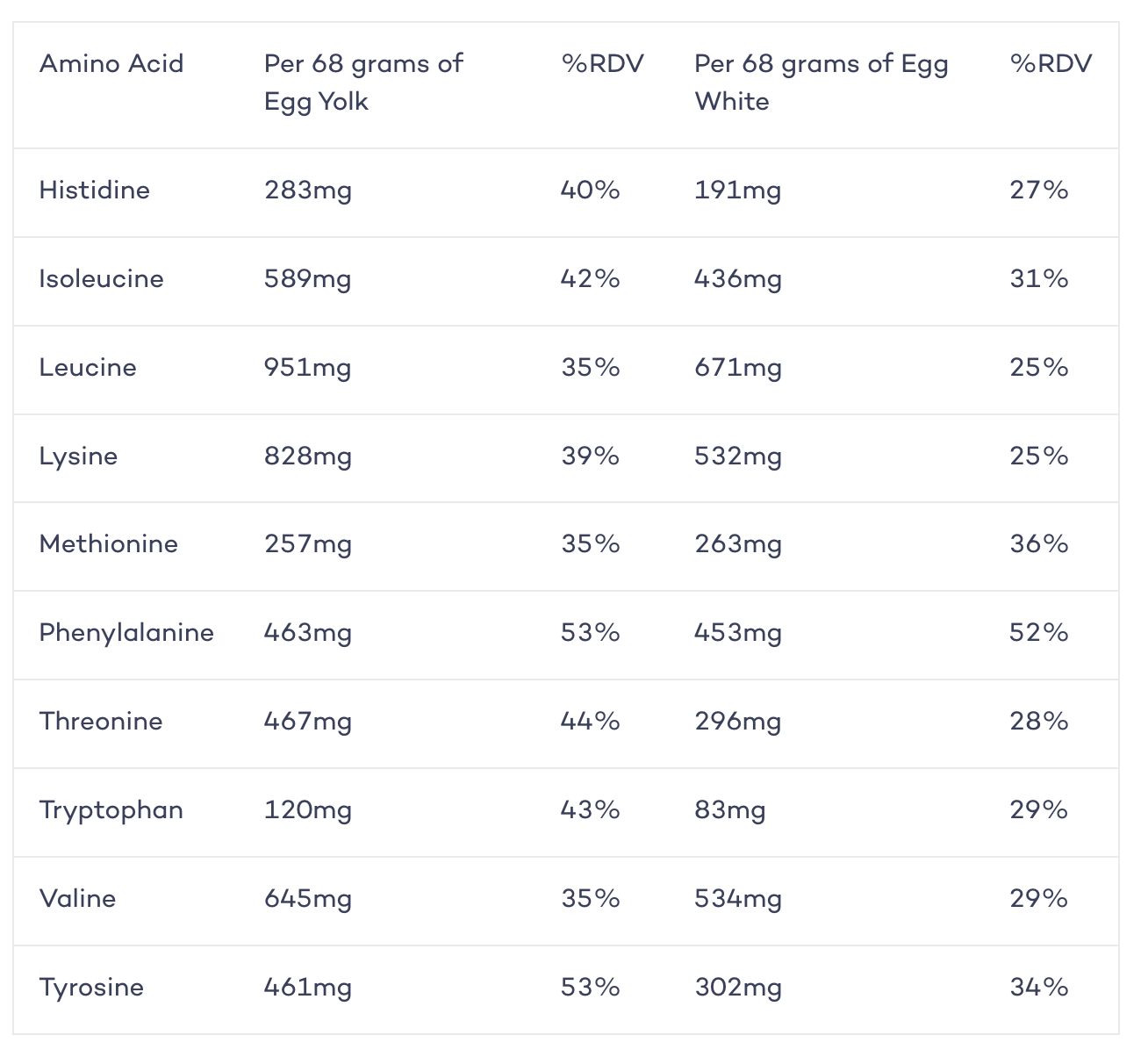
Interestingly, the protein in egg yolk is comprised of higher concentrations of essential and “conditionally essential” amino acids than the protein in egg white.
Take tyrosine for example. Egg yolk provides 20% more of this important amino acid per weight. Your body uses tyrosine to create critical neurotransmitters such as dopamine and adrenaline.
Another important amino acid found in both egg yolk and egg white is tryptophan. This amino acid is integral to the production of melatonin and serotonin. [30] [31] [32]
So, when comparing egg yolk vs egg white, with regards to protein quality, egg yolk comes out slightly ahead :
Groups that May Be Better Off Consuming Only Egg Whites
People with a genetic condition known as hypercholesterolemia should avoid egg yolk and other high-cholesterol foods. These people are colloquially known as “cholesterol hyperresponders.”
Hypercholesterolemia features chronically high blood cholesterol levels and an increased risk for heart disease. [33]
Egg Yolk vs Egg White: The Bottom Line
Eggs are a nutrient-dense whole food that provides an array of vital nutrients. Yet, concerns have been raised about the effects of the cholesterol in egg yolks on heart health. These concerns have led some nutritionists to recommend consuming only egg white, which has essentially no cholesterol.
However, modern research tells us that the cholesterol in eggs does not adversely affect heart health in most people. Only a small subset of people who are genetically predisposed to rapidly absorb dietary cholesterol into their blood may be negatively affected by egg yolk.
Additionally, egg yolk provides the vast majority of nutrients found in eggs, along with a substantial amount of quality protein.
The only marginally science-supported reason to choose egg white over egg yolk is if you are looking to restrict your caloric intake. But even then, research shows that low-carb, high-fat diets that don’t restrict calories are superior to calorie-restricted diets for weight loss.
Egg yolk vs egg white? The verdict is clear–eat whole eggs, yolk and whites!
Article Sources
- 1. S L Roberts, M P McMurry, W E Connor, Does egg feeding (i.e., dietary cholesterol) affect plasma cholesterol levels in humans? The results of a double-blind study, The American Journal of Clinical Nutrition, Volume 34, Issue 10, 1981, Pages 2092-2099, ISSN
- 2. Polymorphisms in the ABCG5 and ABCG8 genes associate with cholesterol absorption and insulin sensitivity
- 3. Njike V, Faridi Z, Dutta S, Gonzalez-Simon AL, Katz DL. Daily egg consumption in hyperlipidemic adults--effects on endothelial function and cardiovascular risk. Nutr J. 2010 Jul 2;9:28. doi: 10.1186/1475-2891-9-28. PMID: 20598142; PMCID: PMC2904713.
- 4. Missimer A, DiMarco DM, Andersen CJ, Murillo AG, Vergara-Jimenez M, Fernandez ML. Consuming Two Eggs per Day, as Compared to an Oatmeal Breakfast, Decreases Plasma Ghrelin while Maintaining the LDL/HDL Ratio. Nutrients. 2017 Jan 29;9(2):89. doi: 10.3390/nu
- 5. Fuller NR, Caterson ID, Sainsbury A, Denyer G, Fong M, Gerofi J, Baqleh K, Williams KH, Lau NS, Markovic TP. The effect of a high-egg diet on cardiovascular risk factors in people with type 2 diabetes: the Diabetes and Egg (DIABEGG) study-a 3-mo randomized
- 6. Katz DL, Gnanaraj J, Treu JA, Ma Y, Kavak Y, Njike VY. Effects of egg ingestion on endothelial function in adults with coronary artery disease: a randomized, controlled, crossover trial. Am Heart J. 2015 Jan;169(1):162-9. doi: 10.1016/j.ahj.2014.10.001. Ep
- 7. Blesso CN, Andersen CJ, Barona J, Volek JS, Fernandez ML. Whole egg consumption improves lipoprotein profiles and insulin sensitivity to a greater extent than yolk-free egg substitute in individuals with metabolic syndrome. Metabolism. 2013 Mar;62(3):400-1
- 8. Blesso CN, Andersen CJ, Bolling BW, Fernandez ML. Egg intake improves carotenoid status by increasing plasma HDL cholesterol in adults with metabolic syndrome. Food Funct. 2013 Feb;4(2):213-21. doi: 10.1039/c2fo30154g. PMID: 23128450.
- 9, 10. Intestinal Microbial Metabolism of Phosphatidylcholine and Cardiovascular Risk
- 11. Carolyn A Miller, Karen D Corbin, Kerry-Ann da Costa, Shucha Zhang, Xueqing Zhao, Joseph A Galanko, Tondra Blevins, Brian J Bennett, Annalouise O’Connor, Steven H Zeisel, Effect of egg ingestion on trimethylamine-N-oxide production in humans: a randomized,
- 12. Intake of up to 3 Eggs/Day Increases HDL Cholesterol and Plasma Choline While Plasma Trimethylamine-N-oxide is Unchanged in a Healthy Population
- 13. Chenghao Zhu, Lisa Sawrey-Kubicek, Allison S. Bardagjy, Hannah Houts, Xinyu Tang, Romina Sacchi, Jody M. Randolph, Francene M. Steinberg, Angela M. Zivkovic, Whole egg consumption increases plasma choline and betaine without affecting TMAO levels or gut mi
- 14. Rikuta Hamaya, Kerry L Ivey, Dong H Lee, Molin Wang, Jun Li, Adrian Franke, Qi Sun, Eric B Rimm, Association of diet with circulating trimethylamine-N-oxide concentration, The American Journal of Clinical Nutrition, Volume 112, Issue 6, 2020, Pages 1448-14
- 15. Jea Woo Kang, Angela M. Zivkovic, Are eggs good again? A precision nutrition perspective on the effects of eggs on cardiovascular risk, taking into account plasma lipid profiles and TMAO, The Journal of Nutritional Biochemistry, Volume 100, 2022, 108906, I
- 16. Sun, J., Ruan, Y., Xu, N. et al. The effect of dietary carbohydrate and calorie restriction on weight and metabolic health in overweight/obese individuals: a multi-center randomized controlled trial. BMC Med 21, 192 (2023). https://doi.org/10.1186/s12916-0
- 17. Réhault-Godbert S, Guyot N, Nys Y. The Golden Egg: Nutritional Value, Bioactivities, and Emerging Benefits for Human Health. Nutrients. 2019 Mar 22;11(3):684. doi: 10.3390/nu11030684. PMID: 30909449; PMCID: PMC6470839.
- 18. Fernstrom JD. Effects on the diet on brain neurotransmitters. Metabolism. 1977 Feb;26(2):207-23. doi: 10.1016/0026-0495(77)90057-9. PMID: 13261.
- 19. Zeisel SH, da Costa KA. Choline: an essential nutrient for public health. Nutr Rev. 2009 Nov;67(11):615-23. doi: 10.1111/j.1753-4887.2009.00246.x. PMID: 19906248; PMCID: PMC2782876.
- 20. Shaw GM, Carmichael SL, Yang W, Selvin S, Schaffer DM. Periconceptional dietary intake of choline and betaine and neural tube defects in offspring. Am J Epidemiol. 2004 Jul 15;160(2):102-9. doi: 10.1093/aje/kwh187. PMID: 15234930.
- 21. Selenium
- 22. Schnabel R, Lubos E, Messow CM, Sinning CR, Zeller T, Wild PS, Peetz D, Handy DE, Munzel T, Loscalzo J, Lackner KJ, Blankenberg S. Selenium supplementation improves antioxidant capacity in vitro and in vivo in patients with coronary artery disease The SEle
- 23. Ju W, Li X, Li Z, Wu GR, Fu XF, Yang XM, Zhang XQ, Gao XB. The effect of selenium supplementation on coronary heart disease: A systematic review and meta-analysis of randomized controlled trials. J Trace Elem Med Biol. 2017 Dec;44:8-16. doi: 10.1016/j.jtem
- 24. Cai X, Wang C, Yu W, Fan W, Wang S, Shen N, Wu P, Li X, Wang F. Selenium Exposure and Cancer Risk: an Updated Meta-analysis and Meta-regression. Sci Rep. 2016 Jan 20;6:19213. doi: 10.1038/srep19213. PMID: 26786590; PMCID: PMC4726178.
- 25. Martijn C. de Wilde, Bruno Vellas, Elodie Girault, Aysun Cetinyurek Yavuz, John W. Sijben, Lower brain and blood nutrient status in Alzheimer's disease: Results from meta-analyses, Alzheimer's & Dementia: Translational Research & Clinical Interventions, Vo
- 26. Guo CH, Liu PJ, Hsia S, Chuang CJ, Chen PC. Role of certain trace minerals in oxidative stress, inflammation, CD4/CD8 lymphocyte ratios and lung function in asthmatic patients. Ann Clin Biochem. 2011 Jul;48(Pt 4):344-51. doi: 10.1258/acb.2011.010266. Epub
- 27. Mrowicka M, Mrowicki J, Kucharska E, Majsterek I. Lutein and Zeaxanthin and Their Roles in Age-Related Macular Degeneration-Neurodegenerative Disease. Nutrients. 2022 Feb 16;14(4):827. doi: 10.3390/nu14040827. PMID: 35215476; PMCID: PMC8874683.
- 28. Mares J. Lutein and Zeaxanthin Isomers in Eye Health and Disease. Annu Rev Nutr. 2016 Jul 17;36:571-602. doi: 10.1146/annurev-nutr-071715-051110. PMID: 27431371; PMCID: PMC5611842.
- 29. Koushan K, Rusovici R, Li W, Ferguson LR, Chalam KV. The role of lutein in eye-related disease. Nutrients. 2013 May 22;5(5):1823-39. doi: 10.3390/nu5051823. PMID: 23698168; PMCID: PMC3708350.
- 30. Jenkins TA, Nguyen JC, Polglaze KE, Bertrand PP. Influence of Tryptophan and Serotonin on Mood and Cognition with a Possible Role of the Gut-Brain Axis. Nutrients. 2016 Jan 20;8(1):56. doi: 10.3390/nu8010056. PMID: 26805875; PMCID: PMC4728667.
- 31. L-Tryptophan: Basic Metabolic Functions, Behavioral Research and Therapeutic Indications
- 32. Zuraikat FM, Wood RA, Barragán R, St-Onge MP. Sleep and Diet: Mounting Evidence of a Cyclical Relationship. Annu Rev Nutr. 2021 Oct 11;41:309-332. doi: 10.1146/annurev-nutr-120420-021719. Epub 2021 Aug 4. PMID: 34348025; PMCID: PMC8511346.
- 33. Warden BA, Fazio S, Shapiro MD. Familial Hypercholesterolemia: Genes and Beyond. 2021 Oct 23. In: Feingold KR, Anawalt B, Blackman MR, Boyce A, Chrousos G, Corpas E, de Herder WW, Dhatariya K, Dungan K, Hofland J, Kalra S, Kaltsas G, Kapoor N, Koch C, Kopp