

Most people who adopt intermittent fasting methods do so to lose weight and improve their metabolic health. Yet intermittent fasting (IF) is among the most promising approaches to enhancing brain function and protecting against age-related cognitive decline.
In this article, we’ll explore the fascinating ways that intermittent fasting impacts brain function. We’ll look at emerging research on the mechanisms through which fasting can stimulate cognitive enhancement, neuroprotection, and overall brain health.
What is Intermittent Fasting?
Intermittent fasting is a dietary practice that involves alternating between periods of eating and fasting.
There are numerous approaches and intensities ranging from the popular “time-restricted eating” methods like the popular 16/8 fast, to OMAD (One Meal a Day), to more intensive multi-day fasts.
These techniques for improving metabolic health mimic the natural periods of deprivation between successful hunts that our hunter-gatherer ancestors adapted to for nearly 2 million years before the dawn of agriculture only 10,000 years ago. [1]
Over this vast expanse of human history, the people whose brains and bodies functioned the best in fasted states became the best at hunting–and ultimately at surviving. Their genes have been passed on to us modern humans despite our overabundance of food.
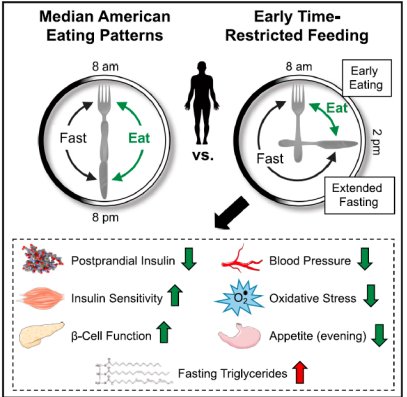
Source: Cell VOLUME 27, ISSUE 6, P1212-1221.E3, JUNE 05, 2018
The theory follows that fasting helps us realign our physiology with our genetic inheritance. One of the most beneficial features of this realignment is improved cognitive function.
Studies show that when we’re full, our cognitive ability diminishes and that when we’re in a fasted state, our brains function optimally. This makes sense when considering that we needed to be extra sharp when food was scarce. [2]
Now, let’s look at some of the specific ways that intermittent fasting may positively impact brain health and function.

Enhanced Cognitive Function
Research on Intermittent fasting has linked it to improvements in cognitive performance, including increased mental clarity, focus, and attention.
The various cognitive benefits of intermittent fasting have to do with the systematic effects and positive feedback responses between organs and physiological systems. In other words, intermittent fasting supports the brain in a holistic way that researchers are still piecing together.
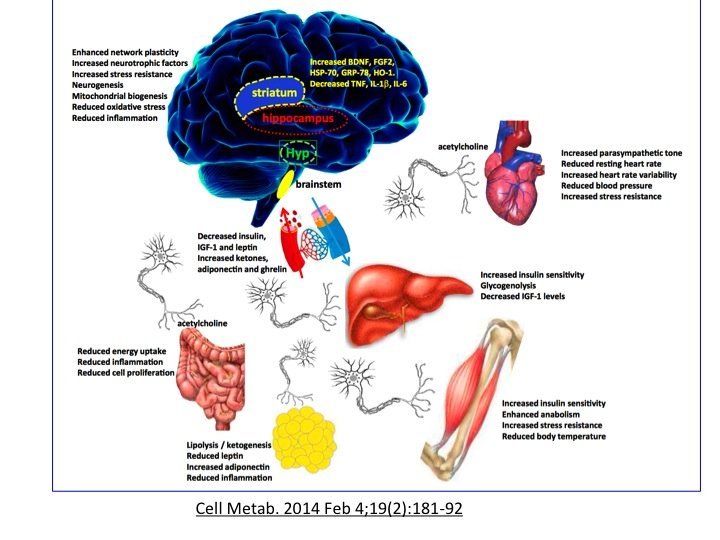
In a study on men with mild cognitive impairment, researchers concluded that “Overall, the MCI-afflicted older adults who practiced IF regularly had better cognitive scores and reverted to better cognitive function at 36 months follow-up.” [3]
A 2021 study on mice found that Intermittent fasting enhances long-term memory consolidation and adult hippocampal neurogenesis of the hippocampus, and increases the expression of a gene linked to longevity called “Klotho.” [4]
Neuroprotection
Intermittent fasting has been shown to protect against age-related neurodegeneration through various mechanisms.
One of the ways that intermittent fasting protects against age-related cognitive decline is by supporting weight loss. Studies show that higher BMI is linked to decreased blood flow to parts of the brain involved in attention, reasoning, and higher function. [5]
A 2020 review of 27 IF clinical trials found that IF resulted in weight loss, ranging from 0.8% to 13.0% of baseline body weight. [6]
Intermittent fasting has also been found to increase the synthesis of ketone bodies (energy molecules made from fat), butanoate metabolism, pyruvate metabolism, and glycolysis and gluconeogenesis, all of which protect against neurodegenerative disorders on a cellular level. [7]
Other studies have found that IF activates various mechanisms that make it an effective approach to preventing vascular dementia–the decline in cognition caused by reduced blood flow to the brain. [8]

Promotes Neurogenesis and Synaptic Plasticity
Neurogenesis refers to the process where stem cells in the brain become neurons that form synapses with other neurons. [9]
In mice, intermittent fasting has been shown to activate various chemical pathways associated with neurogenesis while stimulating the production of a BDNF (brain-derived neurotrophic factor), a protein that helps grow and maintain these new neurons. [10]
Intermittent fasting has been linked to the generation of new neurons in the brain, a process known as neurogenesis. This may have implications for brain health, learning, and memory. However, more research needs to be done on this aspect of fasting and brain function.

Source: Baik S-H, Rajeev V, Fann DY-W, Jo D-G, Arumugam TV. Intermittent fasting increases adult hippocampal neurogenesis. Brain Behav. 2020
Activates Autophagy
Intermittent fasting for at least 16 hours overnight induces a process of cellular repair and renewal called autophagy.
This process removes damaged proteins, cellular debris, and organelles from brain cells, which can improve cognitive function. [11]
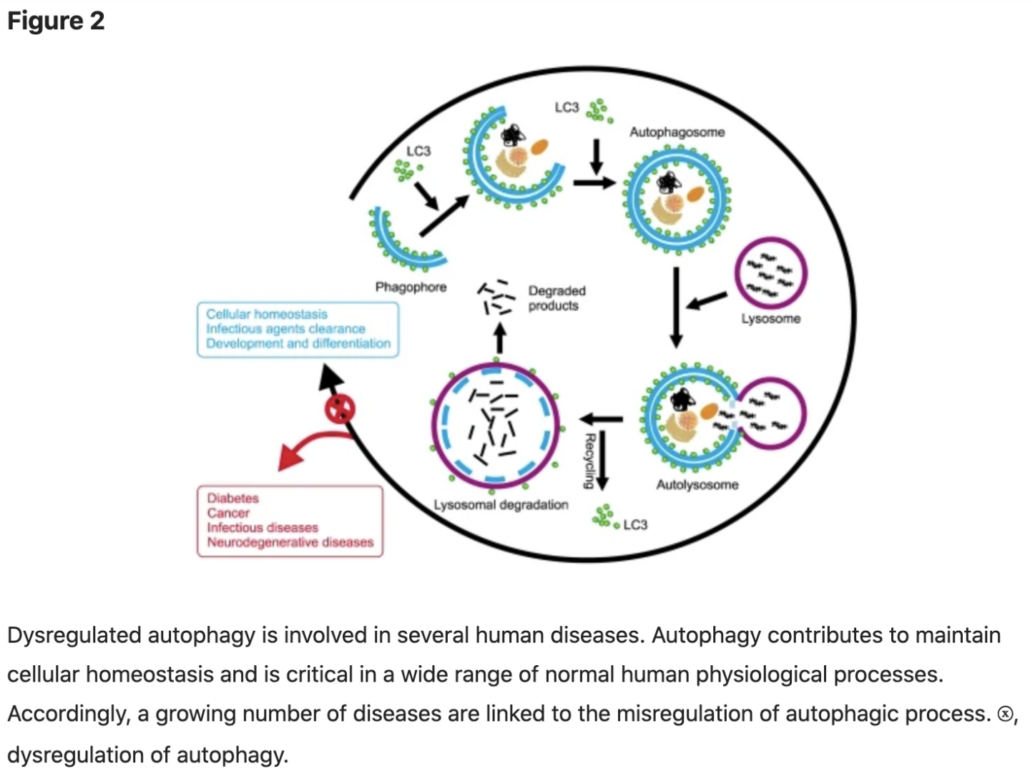
Source: Nature
Reduces inflammation
Chronic inflammation is a root cause of various neurological disorders and cognitive decline. [12] [13] [14]
The good news is that intermittent fasting has routinely been shown to reduce chronic inflammation. [15]
A 2019 study found that intermittent fasting douses inflammation by reducing the presence of inflammatory cells called “monocytes.” Researchers determined that these anti-inflammatory effects are not due to consuming fewer calories. Rather, they come from eating less often, which aligns us with the body’s ancestral metabolic cycles. [16]
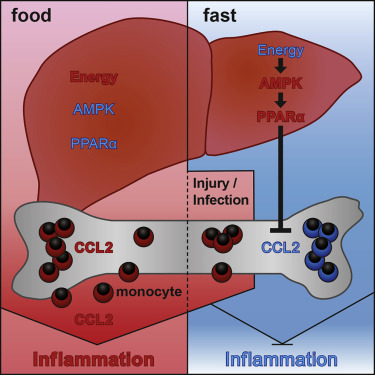
Source: Dietary Intake Regulates the Circulating Inflammatory Monocyte Pool,
Cell, Volume 178, Issue 5, 2019
Other studies reveal that autophagy is a key mediator of inflammation. [17] [18]
Protects the Brain Against Stress
Intermittent fasting stimulates the production of stress-resistance proteins and increases the activity of certain neurotransmitters, including norepinephrine and serotonin. [19] [20]
These transmitters support mood regulation and stress management.
Regulates Blood Sugar
Intermittent fasting has been clinically shown to dramatically regulate blood sugar and improve insulin sensitivity.
Maintaining stable blood sugar levels helps prevent the development of conditions like type 2 diabetes, which can negatively impact brain function.
A systemic review from 2022 found that fasting is so effective at controlling blood sugar and improving insulin resistance that it can be used as a treatment for numerous chronic diseases associated with insulin resistance, including Alzheimer’s. [21] [22]
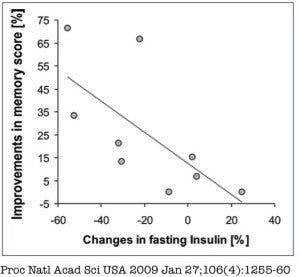
Alzheimer’s has often been called Type-3 diabetes because of its association with chronically elevated blood sugar levels. [23] [24] [25]
Fasting and Brain Function: The Bottom Line
Though research is still emerging, studies reveal numerous mechanisms by which intermittent fasting improves and protects brain function.
Potential benefits of fasting for brain health are due to the ways that fasting:
- Reduces excess weight and increases blood flow to the brain
- Activating various neuropathways associated with growing and maintaining brain cells
- Stimulating autophagy–a process of cellular renewal and repair
- Reducing inflammation
- Protecting your brain from exposure to chronically elevated blood sugar
- Aligning your eating patterns with internal metabolic rhythms that support brain health
Intermittent fasting is likely one of the most effective and systemic lifestyle approaches to supporting brain function.
Article Sources
- 1. The evolution of the human trophic level during the Pleistocene
- 2. Mattson MP. An Evolutionary Perspective on Why Food Overconsumption Impairs Cognition. Trends Cogn Sci. 2019 Mar;23(3):200-212. doi: 10.1016/j.tics.2019.01.003. Epub 2019 Jan 19. PMID: 30670325; PMCID: PMC6412136.
- 3, 7. Ooi TC, Meramat A, Rajab NF, Shahar S, Ismail IS, Azam AA, Sharif R. Intermittent Fasting Enhanced the Cognitive Function in Older Adults with Mild Cognitive Impairment by Inducing Biochemical and Metabolic changes: A 3-Year Progressive Study. Nutrients. 2
- 4. Dias, G.P., Murphy, T., Stangl, D. et al. Intermittent fasting enhances long-term memory consolidation, adult hippocampal neurogenesis, and expression of longevity gene Klotho. Mol Psychiatry 26, 6365–6379 (2021). https://doi.org/10.1038/s41380-021-01102-4
- 5. Willeumier KC, Taylor DV, Amen DG. Elevated BMI is associated with decreased blood flow in the prefrontal cortex using SPECT imaging in healthy adults. Obesity (Silver Spring). 2011 May;19(5):1095-7. doi: 10.1038/oby.2011.16. Epub 2011 Feb 10. PMID: 213115
- 6. Welton S, Minty R, O'Driscoll T, Willms H, Poirier D, Madden S, Kelly L. Intermittent fasting and weight loss: Systematic review. Can Fam Physician. 2020 Feb;66(2):117-125. PMID: 32060194; PMCID: PMC7021351.
- 8. Yoon G, Song J. Intermittent Fasting: a Promising Approach for Preventing Vascular Dementia. J Lipid Atheroscler. 2019 May;8(1):1-7. doi: 10.12997/jla.2019.8.1.1. Epub 2019 Apr 5. PMID: 32821694; PMCID: PMC7379085.
- 9. Kumar A, Pareek V, Faiq MA, Ghosh SK, Kumari C. ADULT NEUROGENESIS IN HUMANS: A Review of Basic Concepts, History, Current Research, and Clinical Implications. Innov Clin Neurosci. 2019 May 1;16(5-6):30-37. PMID: 31440399; PMCID: PMC6659986.
- 10. Baik SH, Rajeev V, Fann DY, Jo DG, Arumugam TV. Intermittent fasting increases adult hippocampal neurogenesis. Brain Behav. 2020 Jan;10(1):e01444. doi: 10.1002/brb3.1444. Epub 2019 Dec 5. PMID: 31804775; PMCID: PMC6955834.
- 11. Alirezaei M, Kemball CC, Flynn CT, Wood MR, Whitton JL, Kiosses WB. Short-term fasting induces profound neuronal autophagy. Autophagy. 2010 Aug;6(6):702-10. doi: 10.4161/auto.6.6.12376. Epub 2010 Aug 14. PMID: 20534972; PMCID: PMC3106288.
- 12. Sartori AC, Vance DE, Slater LZ, Crowe M. The impact of inflammation on cognitive function in older adults: implications for healthcare practice and research. J Neurosci Nurs. 2012 Aug;44(4):206-17. doi: 10.1097/JNN.0b013e3182527690. PMID: 22743812; PMCID:
- 13. Malinowski B, Zalewska K, Węsierska A, Sokołowska MM, Socha M, Liczner G, Pawlak-Osińska K, Wiciński M. Intermittent Fasting in Cardiovascular Disorders-An Overview. Nutrients. 2019 Mar 20;11(3):673. doi: 10.3390/nu11030673. PMID: 30897855; PMCID: PMC64713
- 14. Association of Midlife Inflammatory Markers With Cognitive Performance at 10-Year Follow-up
- 15. Zhou RH, Wang Q, Hu XM, Liu M, Zhang AR. The influence of fasting and caloric restriction on inflammation levels in humans: A protocol for systematic review and meta analysis. Medicine (Baltimore). 2021 Apr 16;100(15):e25509. doi: 10.1097/MD.00000000000255
- 16. Dietary Intake Regulates the Circulating Inflammatory Monocyte Pool
- 17. Netea-Maier RT, Plantinga TS, van de Veerdonk FL, Smit JW, Netea MG. Modulation of inflammation by autophagy: Consequences for human disease. Autophagy. 2016;12(2):245-60. doi: 10.1080/15548627.2015.1071759. Epub 2015 Jul 29. PMID: 26222012; PMCID: PMC4836
- 18. Qian M, Fang X, Wang X. Autophagy and inflammation. Clin Transl Med. 2017 Dec;6(1):24. doi: 10.1186/s40169-017-0154-5. Epub 2017 Jul 26. PMID: 28748360; PMCID: PMC5529308.
- 19. Berthelot E, Etchecopar-Etchart D, Thellier D, Lancon C, Boyer L, Fond G. Fasting Interventions for Stress, Anxiety and Depressive Symptoms: A Systematic Review and Meta-Analysis. Nutrients. 2021 Nov 5;13(11):3947. doi: 10.3390/nu13113947. PMID: 34836202;
- 20. Bastani A, Rajabi S, Kianimarkani F. The Effects of Fasting During Ramadan on the Concentration of Serotonin, Dopamine, Brain-Derived Neurotrophic Factor and Nerve Growth Factor. Neurol Int. 2017 Jun 23;9(2):7043. doi: 10.4081/ni.2017.7043. PMID: 28713531;
- 21. Yuan X, Wang J, Yang S, Gao M, Cao L, Li X, Hong D, Tian S, Sun C. Effect of Intermittent Fasting Diet on Glucose and Lipid Metabolism and Insulin Resistance in Patients with Impaired Glucose and Lipid Metabolism: A Systematic Review and Meta-Analysis. Int
- 22. Witte AV, Fobker M, Gellner R, Knecht S, Flöel A. Caloric restriction improves memory in elderly humans. Proc Natl Acad Sci U S A. 2009 Jan 27;106(4):1255-60. doi: 10.1073/pnas.0808587106. Epub 2009 Jan 26. PMID: 19171901; PMCID: PMC2633586.
- 23. Patterson RE, Laughlin GA, LaCroix AZ, Hartman SJ, Natarajan L, Senger CM, Martínez ME, Villaseñor A, Sears DD, Marinac CR, Gallo LC. Intermittent Fasting and Human Metabolic Health. J Acad Nutr Diet. 2015 Aug;115(8):1203-12. doi: 10.1016/j.jand.2015.02.01
- 24. Nguyen TT, Ta QTH, Nguyen TKO, Nguyen TTD, Giau VV. Type 3 Diabetes and Its Role Implications in Alzheimer's Disease. Int J Mol Sci. 2020 Apr 30;21(9):3165. doi: 10.3390/ijms21093165. PMID: 32365816; PMCID: PMC7246646.
- 25. de la Monte SM, Wands JR. Alzheimer's disease is type 3 diabetes-evidence reviewed. J Diabetes Sci Technol. 2008 Nov;2(6):1101-13. doi: 10.1177/193229680800200619. PMID: 19885299; PMCID: PMC2769828.