

In the realm of nutrition and health, there’s a lot of dogma behind plant-based diets. However, within the world of plant-based foods, there exists a lesser-known and potentially harmful component that deserves our attention: trypsin inhibitors.
These naturally occurring plant compounds, found in common plant foods like grains, soybeans, and many other legumes, can exert subtle yet significant negative effects on our bodies.
In this article, we’ll explore the world of trypsin inhibitors, including what they are, what they do to our bodies, and why it may be a healthy move to avoid consuming them.
What are Trypsin Inhibitors
Trypsin inhibitors are a group of proteins primarily found in plant seeds (grains) and legumes (beans).a [1]
They play a crucial role as a natural defense mechanism for the plant. But when they interact with the human body, they are toxins that can cause damage to bodily tissue, and antinutrients that inhibit nutrient absorption. [2]
Trypsin is an enzyme produced by the pancreas and delivered to the small intestine. There, it initiates digestion by breaking down long chains of amino acids (proteins) into smaller pieces (peptides) that the body can then absorb and utilize. [3]

In addition to its role in food digestion, trypsin has also been found to be an important component of immune function, especially in the intestines. [4]
When considering the importance of trypsin, it’s easy to imagine why trypsin inhibitors can cause problems.
The main function of trypsin inhibitors in plant foods is to defend against predation. It does this by interfering with protein digestion and reducing nutritional value–essentially starving the animals that try to eat it. The genius is that if the animals aren’t deterred by the bitter taste, their population will be driven down through malnutrition.
News flash, when we eat plants we are the predators, and these ancient and finely tuned defense mechanisms are aimed at us!

Foods High in Trypsin Inhibitors
Legumes: The most well-known source of trypsin inhibitors. Legumes include common beans, including kidney, black, and pinto beans, along with lentils, chickpeas, soybeans, peanuts, and cashews. Of all legumes, soybeans contain the highest amount.
Raw Nuts: Most raw nuts contain trypsin inhibitors. When roasted these compounds are greatly diminished.
Seeds: Sunflower and pumpkin seeds also contain trypsin inhibitors. When roasted these compounds are decreased.
Grains: Sweet corn, wheat, wheat bran, and oats are all high in trypsin inhibitors. [5] [6] The inhibitors are often concentrated in the bran layer (outer shell of the kernel).
Potatoes: Potatoes, especially when consumed with their skins. Thoroughly cooked potatoes have lower inhibitor content.
Spinach and leafy greens: Dark leafy greens often contain trypsin inhibitors, though at lower levels than legumes, grains, and nuts.
Effects of Trypsin Inhibitors on Humans
Trypsin inhibitors have various ways of negatively impacting the human body when consumed in excessive amounts.
Let’s take a closer look at some of the most well-studied potential adverse effects.

Poor Protein Digestion
Trypsin inhibitors interfere with trypsin, an enzyme that breaks down proteins from food in the small intestine.
Inhibiting trypsin makes it difficult for the body to digest proteins properly and interferes with overall protein utilization. [7]
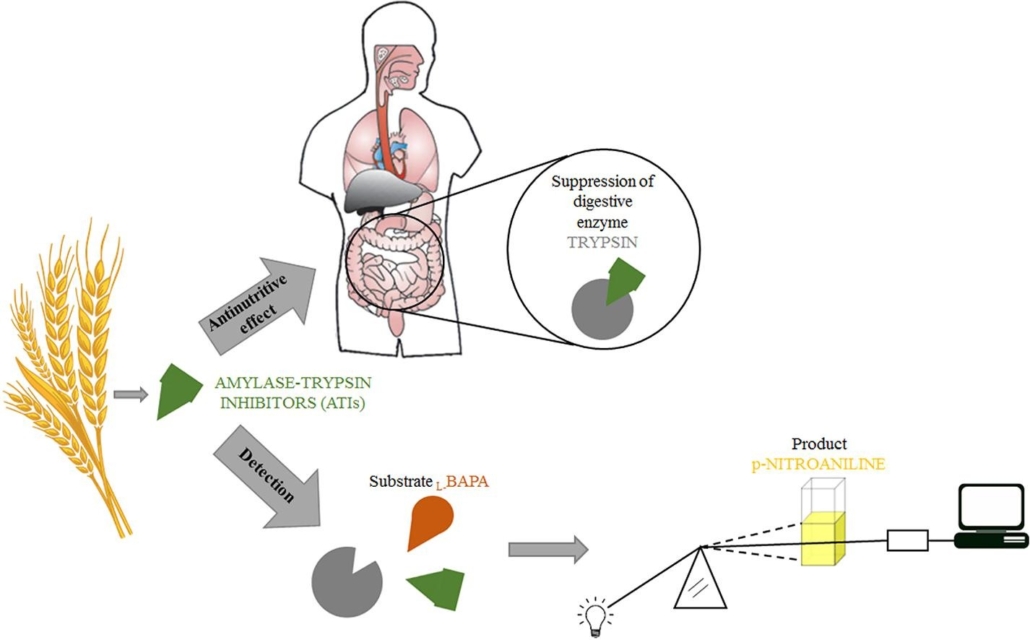
Source: Lisa Call, Elisabeth Viktoria Reiter, Gisela Wenger-Oehn, Irmengard Strnad, Heinrich Grausgruber, Regine Schoenlechner, Stefano D’Amico,
Development of an enzymatic assay for the quantitative determination of trypsin inhibitory activity in wheat, Food Chemistry, Volume 299, 2019
Impeded Nutrient Absorption
In addition to interfering with protein digestion, trypsin inhibitors can impede the digestion of other vital nutrients, including iron and calcium. [8]
These effects are most potentially harmful for people who consume plant-based diets that already provide low quantities of nutrients in formats that are far less bioavailable than animal products. These nutrients are essential for bone health and oxygen transport in the blood.
Gastrointestinal Problems
Consuming foods high in foods rich in trypsin inhibitors can cause gastrointestinal discomfort, including gas, cramps, and diarrhea. [9]
Thyroid Function
Some studies suggest that these inhibitors may negatively impact thyroid function. [10]
Their impact is due to the way they can interfere with the absorption of iodine. The body needs iodine in order to synthesize thyroid hormones. Over time, interference with thyroid hormones can damage the thyroid and negatively impact metabolism.
A 2017 study on mice found that trypsin inhibitors increased oxidative structural damage and pancreatic dysfunction. [11]
Studies on humans have found that trypsin inhibitors affect pancreatic secretions in humans in potentially harmful and carcinogenic ways.
Allergic Reactions
Studies show that these compounds can cause allergic reactions, including rashes and hives, and digestive discomfort. [12]
Soybean trypsin inhibitor (STI) has been singled out a powerful plant allergen that can induce food anaphylaxis. [13]
Allergens from soybean flour and hulls have been causally linked to occupational asthma. [14] [15] [16] [17]
Researchers have found that 20% to 32% of bakers with asthma or rhinitis showed elevated levels of soybean flour-specific antibodies associated with STI. [18]
Trypsin Inhibitors: The Takeaway
Trypsin inhibitors are proteins that occur naturally in plants. Their role is to ward off and even drive down populations of predators by inhibiting nutrient absorption and causing malnutrition.
When consumed chronically and in high concentrations trypsin inhibitors can cause have negative impacts on human health, including
- impeding protein and nutrient absorption
- gastrointestinal distress,
- impaired thyroid function
- pancreatic damage
- allergic reactions.
Ultimately, becoming aware of the presence and effects of trypsin inhibitors in plant foods can empower individuals to make informed dietary choices.
We hope you have a clearer picture of what trypsin inhibitors are, what they do to your body, and why it may be a good choice to avoid foods high in trypsin inhibitors.
Article Sources
- 1. Trypsin Inhibitor
- 2. Antinutrients in Plant-based Foods: A Review Aneta Popova1 and Dasha Mihaylova2,* 1Department of Catering and Tourism, University of Food Technologies, 26 Maritza Blvd., 4002, Plovdiv, Bulg
- 3. Hirota, M., Ohmuraya, M. & Baba, H. The role of trypsin, trypsin inhibitor, and trypsin receptor in the onset and aggravation of pancreatitis. J Gastroenterol 41, 832–836 (2006). https://doi.org/10.1007/s00535-006-1874-2
- 4. Bajaj-Elliott M. Trypsin and host defence: a new role for an old enzyme. Gut. 2003 Feb;52(2):166-7. doi: 10.1136/gut.52.2.166. PMID: 12524392; PMCID: PMC1774981.
- 5. Ingrid Chen, H.L. Mitchell, Trypsin inhibitors in plants, Phytochemistry, Volume 12, Issue 2, 1973, Pages 327-330, ISSN 0031-9422, https://doi.org/10.1016/0031-9422(73)80013-5.
- 6. Geisslitz, S., Weegels, P., Shewry, P. et al. Wheat amylase/trypsin inhibitors (ATIs): occurrence, function and health aspects. Eur J Nutr 61, 2873–2880 (2022). https://doi.org/10.1007/s00394-022-02841-y
- 7. Christian A Barth, Britta Lunding, Martin Schmitz, Hans Hagemeister, Soybean Trypsin Inhibitor(s) Reduce Absorption of Exogenous and Increase Loss of Endogenous Protein in Miniature Pigs123, The Journal of Nutrition, Volume 123, Issue 12, 1993, Pages 2195-
- 8. Pismag, Remigio. (2018). factores antinutricionales en semillas.
- 9. Geisslitz S, Weegels P, Shewry P, Zevallos V, Masci S, Sorrells M, Gregorini A, Colomba M, Jonkers D, Huang X, De Giorgio R, Caio GP, D'Amico S, Larré C, Brouns F. Wheat amylase/trypsin inhibitors (ATIs): occurrence, function and health aspects. Eur J Nutr
- 10. Knezevic J, Starchl C, Tmava Berisha A, Amrein K. Thyroid-Gut-Axis: How Does the Microbiota Influence Thyroid Function? Nutrients. 2020 Jun 12;12(6):1769. doi: 10.3390/nu12061769. PMID: 32545596; PMCID: PMC7353203.
- 11. Gu C, Yang Q, Li S, Zhao L, Lyu B, Wang Y, Yu H. Effects of Soybean Trypsin Inhibitor on Pancreatic Oxidative Damage of Mice at Different Growth Periods. Foods. 2023; 12(8):1691. https://doi.org/10.3390/foods12081691
- 12. Bellinghausen I, Weigmann B, Zevallos V, Maxeiner J, Reißig S, Waisman A, Schuppan D, Saloga J. Wheat amylase-trypsin inhibitors exacerbate intestinal and airway allergic immune responses in humanized mice. J Allergy Clin Immunol. 2019 Jan;143(1):201-212.e
- 13. Soybean trypsin inhibitor is an occupational inhalant allergen Santiago Quirce, MD, PhD Mar Fernández-Nieto, MD Florentino Polo, PhD Joaquín Sastre, MD, PhD DOI:https://doi.org/10.1067/mai.2002.120952
- 14. Bush RK, Schroeckenstein D, Meier-Davis S, Balmes J, Rempel D. Soybean flour asthma: detection of allergens by immunoblotting. J Allergy Clin Immunol. 1988 Aug;82(2):251-5. doi: 10.1016/0091-6749(88)91007-x. PMID: 3042839.
- 15. Baur X, Sauer W, Weiss W. Baking additives as new allergens in baker's asthma. Respiration. 1988;54(1):70-2. doi: 10.1159/000195503. PMID: 3244911.
- 16, 17. Baur X, Pau M, Czuppon A, Fruhmann G. Characterization of soybean allergens causing sensitization of occupationally exposed bakers. Allergy. 1996 May;51(5):326-30. doi: 10.1111/j.1398-9995.1996.tb04617.x. PMID: 8836337.
- 18. Schägger H, von Jagow G. Tricine-sodium dodecyl sulfate-polyacrylamide gel electrophoresis for the separation of proteins in the range from 1 to 100 kDa. Anal Biochem. 1987 Nov 1;166(2):368-79. doi: 10.1016/0003-2697(87)90587-2. PMID: 2449095.
Follow Dr. Kiltz on Social Media for Daily Information and Inspiration
Subscribe to follow our Blog
Type your email*
Submit
Follow us on Social Media


